Be the Answer · Episode 02 · 6:48
Who AI Trusts: How AI Chooses Its Sources and How to Become One
When a buyer asks an AI assistant a question, a few pages get cited under the answer and most brands are left out. In this episode, we open the black box: how AI answers are built from training memory and live retrieval, the four qualities that make a page worth citing (extractability, corroboration, specificity and visible credibility), and the practical steps to make your brand one of the sources AI trusts.
Key takeaways
What you will learn
- AI answers draw on two layers: what the model learned in training and pages it retrieves live, and live retrieval is where brands can make progress now.
- Assistants favor pages that state the answer plainly and early, so a direct answer near the top makes your content easy to quote.
- Claims carry more weight when independent sources confirm them, and specific, original detail beats generic, polished content.
- To become a source, start from your buyers' real questions, check who AI cites today, build the clearest answer for each one and earn independent corroboration.
Transcript
Full episode transcript
Introduction
Welcome to Be the Answer, the podcast from Aurum Digital about how premium brands get found, trusted and recommended in the age of AI search. I'm your host, and today we're opening the black box: how AI chooses its sources, and how your brand can become one of them.
Why some pages get cited
Let's start with a simple scene. A buyer types into an AI assistant: what is the best way to protect a leather sofa from sun damage? In a few seconds, they get a confident answer. Three steps, a product type to look for, and a short note on what to avoid. Under that answer sit two or three small links. Those links are the sources. One of them might be a brand. Most brands in that category are not there. So the real question for today is: why those pages, and not yours?
How an AI answer is built
First, let's look at how an AI answer is actually built. There are two layers. The first layer is what the model learned during training, a broad memory of the web, of books, and of public conversations. That memory shapes which brands feel familiar to the model. The second layer is live retrieval. For many questions, the assistant runs its own searches, pulls a handful of pages, reads them, and writes an answer from what it found. That second layer is where you can win this month, not in two years. Because when the assistant goes looking, it is choosing pages in real time, and it chooses them for reasons you can understand.
Four qualities of a citable page
So, what makes a page worth citing? Think about it from the assistant's point of view. It has a question, a few seconds, and a pile of pages. It wants the page that answers the question most clearly, with the least risk of being wrong.
That gives us the first quality: extractability. The best sources say the answer plainly, early, in a sentence that could be lifted and quoted. A page that opens with three paragraphs about the company's history before it gets to the point is hard to use. A page that starts with a direct answer, then explains the reasoning, is easy to use.
The second quality is corroboration. Assistants are cautious. When several independent sources agree on a fact, the assistant feels safe repeating it. When only your own website says something, it carries less weight. Your claims become more citable when others confirm them: industry publications, reviews, experts, and community discussions.
The third quality is specificity. Generic content is everywhere, and the assistant has no reason to pick yours. Original detail is rare. Your own process, your real measurements, your clear definitions, a framework you actually use with customers. Specific beats polished, every time.
And the fourth quality is credibility you can see on the page. A named author with real experience. A clear date showing when it was last updated. Sources for any facts you cite. These are signals a careful reader looks for, and AI systems are built to imitate careful readers.
How to become a source
Now, how do you become one of those sources? Here is the practical part.
Start with the questions, not the keywords. Write down the real questions your buyers ask before they choose a brand like yours. Ask your sales team. Read your support emails. Then type those questions into the major AI assistants and note which sources they cite today. That list is your competition, and it is often not who you expect.
Next, build the best answer for each important question. One clear page per question, or one strong section in a larger guide. Lead with the direct answer. Use descriptive headings that mirror the way people ask. Add the specific details only you can provide. Keep it updated, and show the date.
Then make sure the machines can actually read it. If your key content is hidden behind heavy scripts, slow pages, or blocked crawlers, the assistant may never see it. Check that your important pages load fast, render as plain text, and are not blocked for the crawlers that AI search depends on.
Finally, earn the corroboration. Share your expertise where your industry already listens. Contribute insight to respected publications, show up in relevant community discussions with real answers, and encourage honest reviews. You are building a chorus of independent voices that confirm what your own site says.
Three takeaways
Let's wrap up with three takeaways.
One: AI answers come from both memory and live search, and live search is where you can make progress right now.
Two: assistants cite pages that are easy to quote, specific, credible, and confirmed by other sources. Write for that.
Three: start from your buyers' real questions, check who gets cited today, and build the clearest answer on the web for each one.
Wrapping up
If you want to know which sources AI trusts in your category, and what it would take for your brand to be one of them, visit aurumdigital.org and request a free audit. We'll show you where you stand and what to fix first.
And if this episode was useful, follow Be the Answer so you don't miss the next one. Next time, we'll talk about entity SEO, and how to make sure AI knows exactly who you are. Thanks for listening.
Related services:
Free download
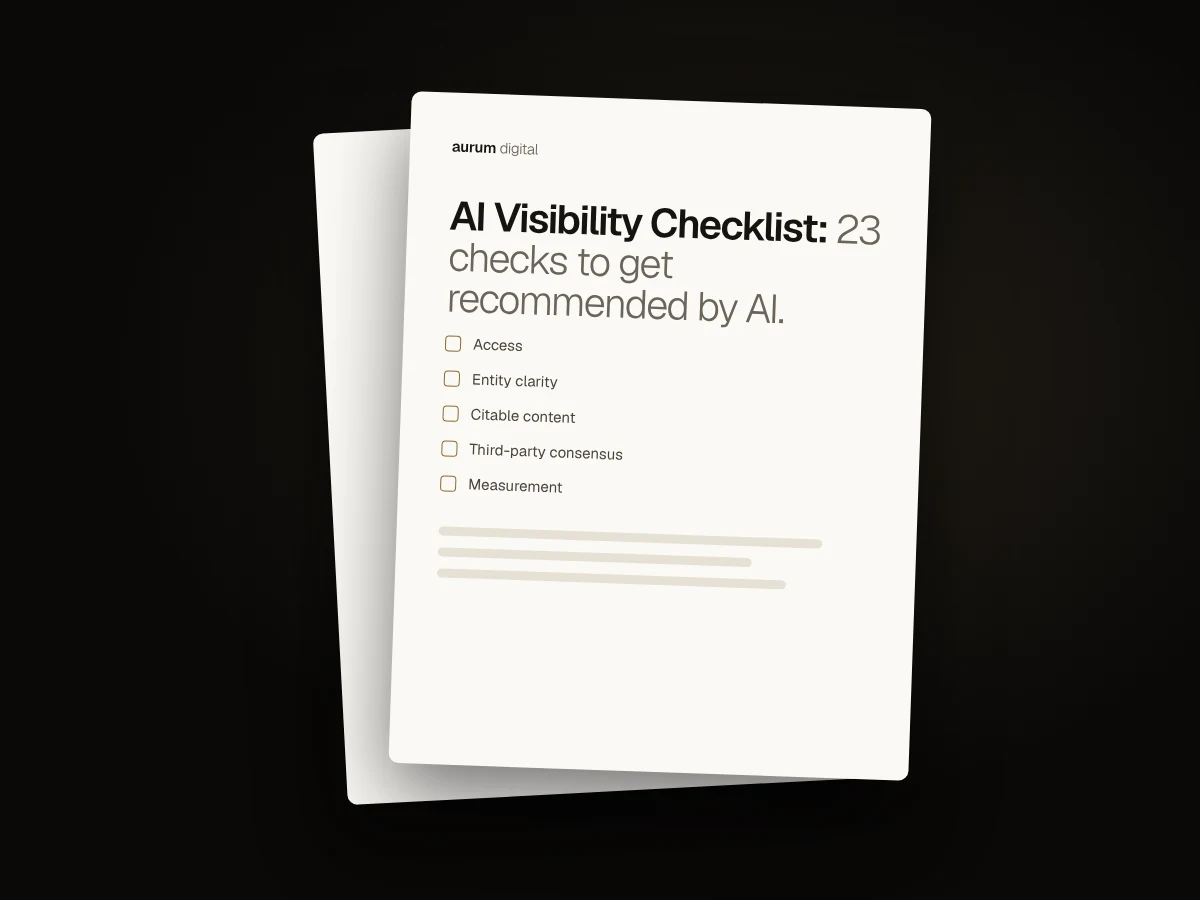
The AI Visibility Checklist
23 checks to see how ready your website and brand are to be found, understood and cited by ChatGPT, Gemini, Perplexity, Claude and Google AI Overviews. Two pages, PDF.
Next step
Turn this episode into a plan for your brand
Get a free audit of how Google and AI assistants see your website, delivered as a digital report within 3 business days.
Delivered within 3 business days · Digital report (PDF) · No obligation