Be the Answer · Episode 03 · 7:13
Entity SEO: Making Sure AI Knows Exactly Who You Are
Before an AI assistant can recommend a brand, it has to answer a simpler question: who exactly is this? In this episode of Be the Answer we explain entity SEO, the three layers AI uses to learn who you are (your website, the profiles you control and independent sources), the quiet identity problems that keep premium brands out of AI answers, and how to fix them with one consistent version of your brand.
Key takeaways
What you will learn
- Write a one- or two-sentence entity statement with your official name, category, audience and location, and use it everywhere.
- Ask AI assistants to describe your brand, then align your about page, structured data, listings and profiles so they all say the same thing.
- Earn accurate mentions from credible independent sources, because outside confirmation turns your claims into facts AI can trust.
- Watch for quiet entity problems like name drift, category confusion, stale facts and a thin footprint before they cost you AI recommendations.
Transcript
Full episode transcript
Welcome and a simple identity test
Welcome to Be the Answer, the podcast from Aurum Digital about how premium brands get found, trusted and recommended in Google and in AI search. I'm your host, and today we're talking about entity SEO: making sure AI knows exactly who you are.
Let's start with a simple test. Imagine a boutique architecture studio called North Atelier. A potential client asks an AI assistant, who designs modern lake houses in the Midwest? The assistant knows a North Atelier exists. But it also finds a furniture shop with almost the same name, an old address from before the studio moved, and a directory listing that calls it an interior design firm. So the assistant hedges. It mentions two competitors with clear, consistent profiles, and leaves North Atelier out. Nothing was wrong with the work. The problem was identity.
What entity SEO means
That's what entity SEO is about. In the last two episodes we looked at how AI search changes discovery and how AI chooses its sources. Today we go one level deeper, to the question every AI system has to answer before it can recommend you: who exactly is this?
So, what is an entity? An entity is a thing that can be clearly identified. A person, a company, a product, a place. Search engines and language models don't just store words, they store relationships between things. This brand is a company. It was founded by this person. It offers these services. It is located in this city. It is known for this specialty. When those facts are clear and agree with each other everywhere, the system can describe you with confidence. When they're fuzzy or contradictory, it hesitates, and in AI answers, hesitation usually means you're left out.
Keywords still matter. But keywords answer the question, what is this page about? Entities answer a bigger question, what is this brand, and can I trust what I know about it? AI assistants lean heavily on that second question, because they are summarizing, not just listing links.
How AI learns who you are
Now, how does AI actually learn who you are? Think of it as three layers.
The first layer is your own website. Your home page, your about page, your service pages and your team bios are the official record. If your about page is vague, or your services are described differently on every page, you're sending mixed signals from your own front door. Structured data helps here too. Organization markup, with your official name, logo, founding details and links to your official profiles, gives machines a clean summary they don't have to guess.
The second layer is the profiles you control elsewhere. Your business listings, your social profiles, your professional directories and industry associations. Each one is a small vote on who you are. If the name, the description and the category match, those votes add up. If one says boutique architecture studio and another says home remodeling, the votes cancel out.
The third layer is what independent sources say about you. Press coverage, interviews, podcast appearances, awards, reviews and mentions in respected publications. This is where AI goes to confirm that your own description is true. A brand that describes itself as a leader, with no outside source agreeing, looks like a claim. A brand that is described the same way by others looks like a fact.
Where brand identity goes wrong
So what goes wrong? Most entity problems are quiet. Nobody notices them until an AI answer gets you wrong. The most common one is name drift. The brand is written one way on the website, another way on social media, and with an old legal suffix in directories. Another is category confusion, where different sources put you in different industries. A third is stale facts: old addresses, former founders, discontinued services that still appear in listings and in articles. And the last one is the thin footprint, where there's simply not enough independent information for AI to form a clear picture at all.
The fix is not a single tactic. It's discipline. Decide on one official version of your identity, and then make the rest of the internet match it.
Three practical takeaways
Here are three practical takeaways for this week.
First, write your entity statement. One or two sentences that say exactly who you are, what you do, who you serve and where. Use the same official name and the same category every time. This becomes the source of truth for your website, your profiles and your press materials.
Second, audit and align your footprint. Ask a few AI assistants to describe your brand, and note anything that's missing, outdated or wrong. Then go through your about page, your structured data, your business listings and your main profiles, and update them so they all say the same thing.
Third, build outside confirmation. Look for credible places where your expertise naturally belongs: industry publications, interviews, associations, expert roundups. Every accurate mention from an independent source makes your identity clearer and harder for AI to ignore.
Closing and free audit
When AI knows exactly who you are, it can finally do what you want it to do: recommend you with confidence.
If you'd like to know how clearly AI understands your brand today, visit aurumdigital.org and request a free audit. We'll show you what AI says about you, where the gaps are, and what to fix first.
Thanks for listening. Follow Be the Answer so you don't miss the next episode, and I'll see you next week.
Related services:
Free download
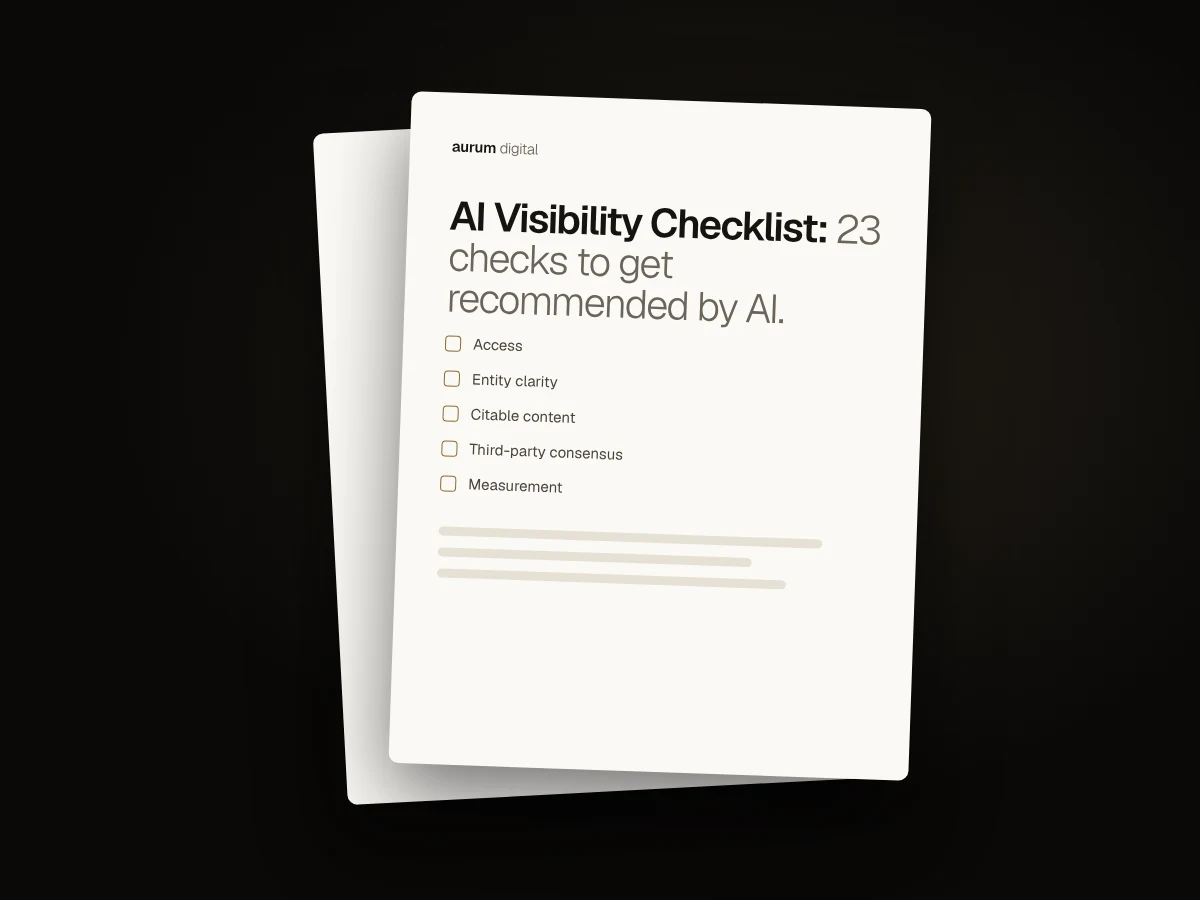
The AI Visibility Checklist
23 checks to see how ready your website and brand are to be found, understood and cited by ChatGPT, Gemini, Perplexity, Claude and Google AI Overviews. Two pages, PDF.
Next step
Turn this episode into a plan for your brand
Get a free audit of how Google and AI assistants see your website, delivered as a digital report within 3 business days.
Delivered within 3 business days · Digital report (PDF) · No obligation