Insights · GEO vs SEO
GEO vs SEO: what changes, what stays the same and how to run both.
SEO earns your pages a place in search results; GEO earns your brand a place inside the answers AI assistants write. They share the same foundation, so the smartest move is not to choose between them but to run them as one program with two scoreboards.
Key takeaways
- Google says there are no extra requirements or special optimizations needed to appear in AI Overviews or AI Mode: a page has to be indexed and eligible to show a snippet, which is classic SEO.
- What changes is the goal (a mention or citation instead of a ranking), the unit of work (questions instead of keywords) and the weight of signals outside your site, such as consistent facts and independent coverage.
- Several AI platforms separate search crawlers from training crawlers, so you can stay visible in AI answers while opting out of model training, as long as you set robots.txt rule by rule.
- Run both from one audit, one content plan, one authority plan and one dashboard that combines Search Console, Bing's AI Performance report, AI referral traffic and a tracked prompt set.
The short answer
Search Engine Optimization (SEO) is the work of getting your pages to rank in Google and Bing so buyers click through to your site. Generative Engine Optimization (GEO) is the work of getting your brand mentioned, described accurately and cited when buyers ask ChatGPT, Gemini, Perplexity, Claude, Copilot or Google's AI Overviews a question. If you are new to the term, start with our guide What is Generative Engine Optimization?
The two overlap far more than most vendors admit. AI assistants that search the web before answering rely on pages they can crawl, index and trust, which is exactly what SEO builds. But GEO changes what you aim for, which signals deserve more attention and how you prove progress. The rest of this article shows where the line falls and how to manage both without paying twice for the same work.
What stays the same
The clearest statement comes from Google itself. Its documentation on AI features says there are no additional requirements to appear in AI Overviews or AI Mode, and no special optimizations are necessary. To be shown as a supporting link, a page must be indexed and eligible to appear in Google Search with a snippet. There is also no special structured data you need to add. In other words, if your SEO is broken, your visibility in Google's AI features is broken too.
The same logic applies outside Google. OpenAI says sites that opt out of its search crawler, OAI-SearchBot, will not be shown in ChatGPT search answers. Perplexity describes PerplexityBot as the crawler that surfaces and links websites in its results. Anthropic says blocking Claude-SearchBot or Claude-User may reduce a site's visibility in Claude's search results. Access, crawlability and indexing are the entry ticket for both disciplines.
- Technical health. Fast, crawlable pages with important content in the HTML, a clean sitemap and no accidental blocks in robots.txt, your CDN or your firewall.
- Helpful, specific content. Pages that answer real questions clearly, with facts, examples and sources. Google's guidance for its AI experiences repeats its long-standing advice to focus on unique, valuable content for people.
- Authority. Links and mentions from relevant, trusted sites still help pages rank, and the same publications often appear among the sources AI answers cite.
- Structured data that matches the page. Google asks that markup reflect the visible text. It helps systems read facts correctly, though it is not a shortcut to being cited.
What changes
GEO does not add a new set of tricks. It shifts the emphasis in five places, and each shift changes how you plan and report the work.
- The goal. SEO wins a position and a click. GEO wins a mention, an accurate description and ideally a citation, sometimes with no click at all. A buyer who reads your name in a shortlist of three has been influenced even if they visit your site days later by typing your URL.
- The unit of work. SEO plans around keywords. GEO plans around questions, often long and conversational, such as which firm is best for a specific need, budget or location. Google notes that AI Overviews and AI Mode may use query fan-out, running several related searches across subtopics before writing a response, so one question can pull sources from many different pages.
- The weight of off-site signals. In SEO, your own pages do most of the work. In GEO, what independent sources say about you carries more weight, because assistants assemble answers from many places. Reviews, directory profiles, press coverage and community discussion all shape the description a model gives.
- Entity clarity. An assistant has to know exactly who you are before it can recommend you. Your name, category, services, locations and key facts need to be stated the same way on your site, your profiles and the sources that mention you. See the glossary for entity, consensus and related terms.
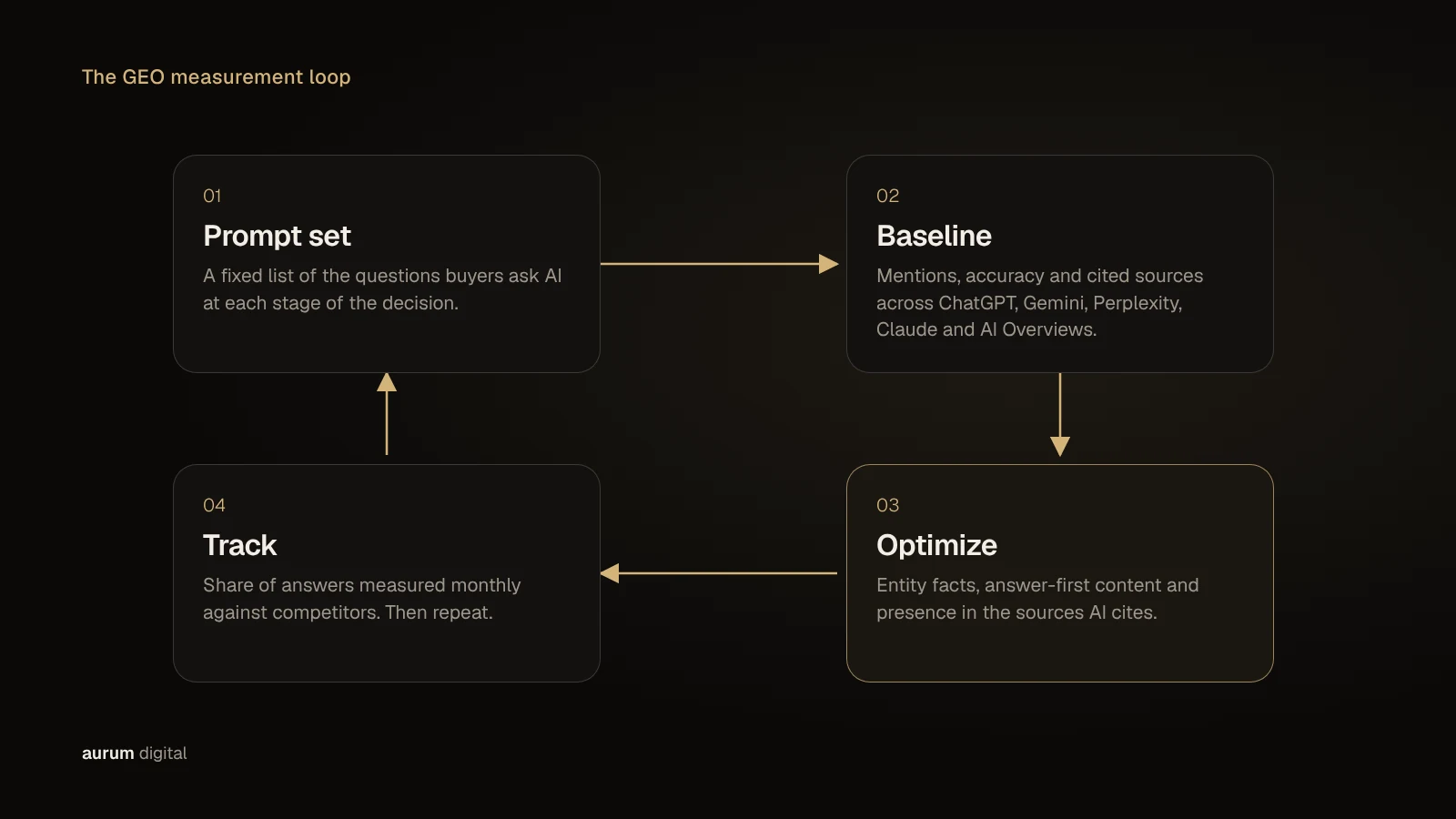
- Measurement. Rank trackers cannot tell you whether ChatGPT recommends you. GEO adds a prompt set tracked across platforms, plus new reports from the search engines themselves, covered below.
Where SEO and GEO pull in different directions
Most of the time, good SEO and good GEO point the same way. There are three decisions where they can conflict, and it pays to make them deliberately.
| Decision | Pure SEO view | Pure GEO view | How to run both |
|---|---|---|---|
| Blocking AI crawlers | Irrelevant to rankings | Blocking search crawlers removes you from answers | Allow search crawlers, decide on training crawlers separately |
| Answering in full on the page | Hold something back to earn the click | Give the complete answer so it can be quoted | Answer directly up top, keep depth, tools and proof on the page |
| Where to spend authority budget | Links that pass ranking value | Mentions in sources AI cites, linked or not | Prioritize publications that do both |
The crawler decision deserves care because the platforms now separate search from training. OpenAI says its settings are independent, so a site can allow OAI-SearchBot for search while disallowing GPTBot, its training crawler. Anthropic draws a similar line between ClaudeBot, used for training, and Claude-SearchBot and Claude-User, used for search and user requests. Google states that its Google-Extended token, which governs use in Gemini training and grounding, does not affect inclusion or ranking in Google Search. Blanket rules that block every AI bot can quietly remove you from the answers your buyers read.
How to run SEO and GEO as one program
Treating GEO as a separate project with its own agency, its own content calendar and its own reports usually means paying twice for overlapping work. A single program with two scoreboards is cheaper and easier to manage.
- One audit. Check technical health, indexing and rankings alongside how AI assistants describe you today, which competitors they name and which sources they cite. Both halves inform the same priority list.
- One crawler policy. Review robots.txt, CDN and firewall rules for Googlebot, Bingbot, OAI-SearchBot, PerplexityBot and Claude-SearchBot, and make a separate, explicit decision on training crawlers such as GPTBot, ClaudeBot and Google-Extended.
- One content plan built on questions. Map the questions buyers ask at each stage, then assign each one to a page. Write answer-first, with clear headings, tables and FAQs. Microsoft's own advice for being cited in Copilot makes the same point: clear structure helps surface key information.
- One entity sheet. Agree the official description, services, locations and facts, then make your site, structured data and profiles match it.
- One authority plan. Use digital PR to earn coverage in publications that rank well and that AI answers already cite in your category. The same story can earn a link that helps rankings and a mention that shapes AI descriptions.
- One dashboard. Report classic search and AI visibility side by side every month, then review priorities every quarter.
This is how we structure client work: organic growth and technical SEO, link building and digital PR and GEO services sharing one roadmap rather than competing for budget.
How to measure both together
You do not need an expensive platform to start. Most of the data already exists in free tools, as long as you know where it lives and what it can and cannot tell you.
| Signal | Where to find it | What it tells you |
|---|---|---|
| Impressions and clicks, including AI Overviews and AI Mode | Google Search Console, Performance report, Web search type | Overall Google visibility; Google counts AI feature traffic inside overall search data |
| Citations and grounding queries | Bing Webmaster Tools, AI Performance (public preview) | How often Copilot, Bing AI summaries and partners cite your pages, and for which queries |
| AI referral visits | Your analytics, by referrer such as chatgpt.com or perplexity.ai | Traffic and conversions from assistants; ChatGPT adds utm_source=chatgpt.com to links |
| Share of answers | A fixed prompt set checked monthly across assistants | Whether you are mentioned, how accurately, and which sources are cited |
| Leads and revenue | CRM and analytics | Whether visibility in either channel turns into business |
Two cautions. Bing describes its grounding query data as a sample, and its citation counts as frequency, not ranking or importance. And AI answers vary from run to run, so look at trends across several months rather than any single check. Google also advises looking beyond clicks to conversions and engagement, noting that clicks from AI Overviews tend to be higher quality.
Where to put the effort first
The right split depends on where you start, not on a fixed ratio. Use your audit to place yourself in one of these situations.
- Weak technical foundations or poor indexing. Fix SEO first. Neither Google's AI features nor assistants that search the web can use pages they cannot reach.
- Strong rankings, missing from AI answers. Shift effort toward entity clarity, third-party presence and question-led content. This gap is common for brands that rank well on their own site but have thin coverage elsewhere.
- Mentioned, but described inaccurately. Correct the facts at the source: your site, your profiles and the pages the assistants cite. Then check again after those pages are recrawled.
- New brand with little history. Build both at once: a solid site, consistent profiles and a steady stream of earned coverage. AI systems need corroboration from independent sources before they describe you with confidence.
Start this month
- Ask ten real buyer questions in ChatGPT, Gemini, Perplexity, Claude and Copilot, and note who is named and which sources are cited.
- Check robots.txt and your CDN for the search crawlers listed above, and decide on training crawlers separately.
- Verify your site in Google Search Console and Bing Webmaster Tools, and open the AI Performance report in Bing.
- Set up an AI referral segment in your analytics.
- Rewrite your three most important service or product pages so the answer to the main buyer question sits in the first paragraph.
Our free AI Visibility Checklist covers these steps in 23 checks. For a spoken take on how assistants pick their sources, listen to episode 2 of Be the Answer. If you would rather have us do it, request a free SEO and AI visibility audit.
FAQ
Frequently asked questions
What is the difference between GEO and SEO?
SEO aims to rank pages in search results and earn clicks. GEO aims to get a brand mentioned, described accurately and cited inside answers written by AI assistants and AI search features. GEO builds on SEO foundations but adds a focus on questions, entity clarity, third-party sources and a different way of measuring.
Is SEO still worth investing in because of AI search?
Yes. Google says pages must be indexed and eligible to show a snippet to appear in AI Overviews and AI Mode, and other assistants rely on their own search crawlers. Strong SEO is the entry ticket for most AI visibility.
Do I need different content for GEO and SEO?
Usually not. The same answer-first page, with clear headings, specific facts, tables and FAQs, serves both. What changes is planning: map pages to the questions buyers ask, not only to keywords.
Can I block AI training without disappearing from AI answers?
On several platforms, yes. OpenAI, Anthropic and Google use separate robots.txt user agents or tokens for training and for search, so you can allow the search crawlers and disallow the training ones. Check each platform's documentation before changing rules.