Insights · GEO guide
What is Generative Engine Optimization? A practical guide for brands.
Generative Engine Optimization (GEO) is the practice of improving how AI assistants such as ChatGPT, Gemini, Perplexity, Claude and Google's AI Overviews understand, mention and cite your brand. This guide explains how those answers are built, how GEO differs from SEO and where to start.
Key takeaways
- GEO is about being mentioned, described accurately and cited inside AI-generated answers, not only ranking in a list of links.
- AI answers draw on what a model learned in training and on sources it retrieves at the moment of the question, so both your own site and third-party coverage matter.
- GEO builds on SEO foundations: crawlable pages, clear entities, authoritative links and content that answers questions directly.
- It is measured differently, with a fixed set of buyer questions tracked across AI platforms over time.
GEO in plain English
When a buyer types a question into a search engine, they get a list of links and choose where to click. When they ask an AI assistant, they get a written answer, often with a short list of recommended brands and a few cited sources. Generative Engine Optimization is the work of making sure your brand is part of that answer, and that what the assistant says about you is accurate.
The term comes from a 2023 research paper by computer scientists at Princeton University and other institutions, who called these systems generative engines: search experiences that generate an answer instead of returning a ranked list. In practice you will also hear Answer Engine Optimization (AEO), AI SEO or LLM optimization. They describe the same discipline, and the work behind them is the same.
How AI assistants build an answer
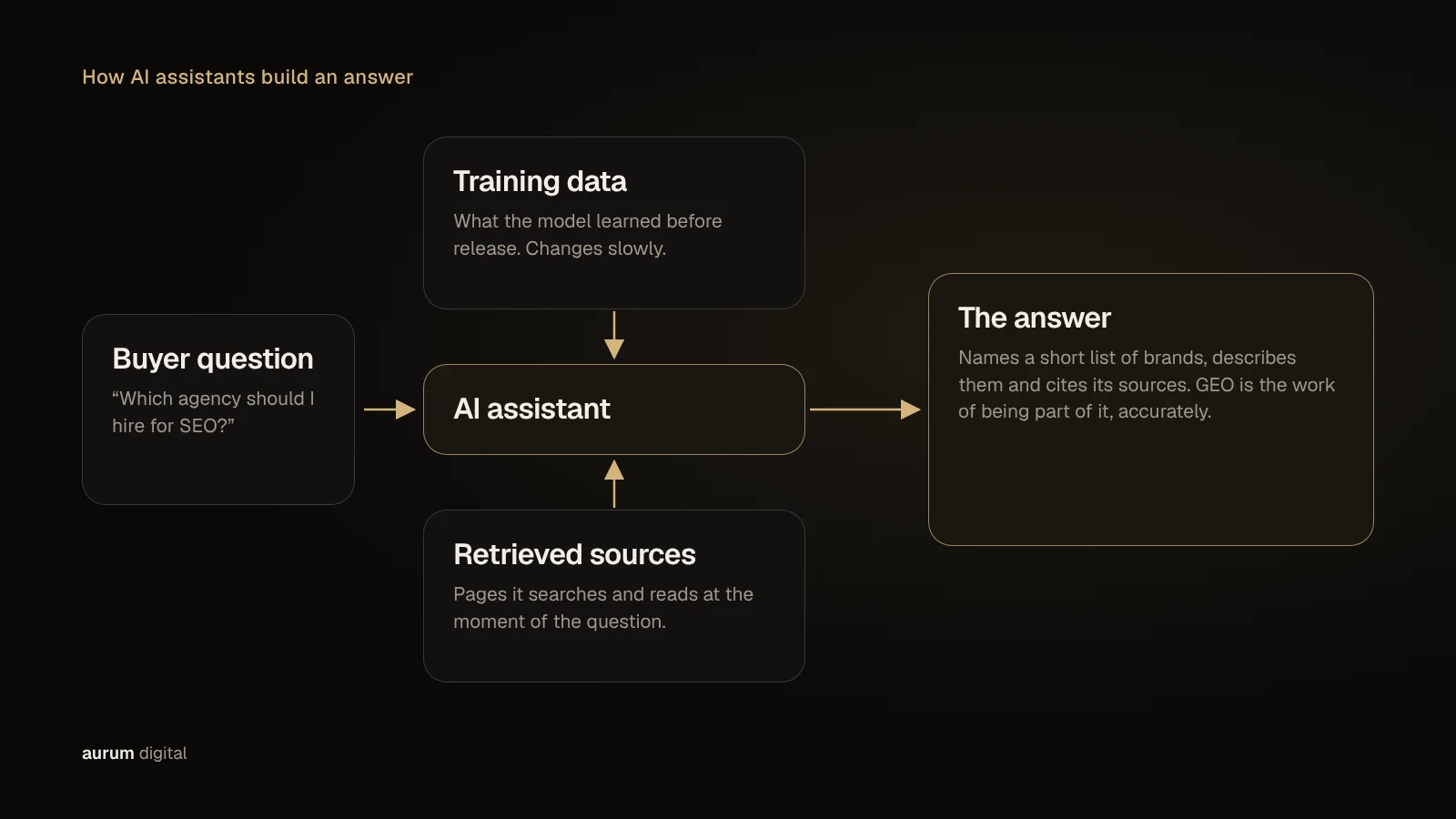
To understand GEO, it helps to know where an AI answer comes from. There are two main sources, and most modern assistants use both.
The first is the model's training data: the large body of text it learned from before release. This is where its general knowledge of your category, your competitors and possibly your brand comes from. It changes slowly, only when a new model version is trained.
The second is retrieval. For many questions, especially about products, services or anything recent, the assistant runs a search, reads a handful of pages and writes its answer from them. This is often called retrieval-augmented generation (RAG). The pages it reads are the ones it can find, access and trust, which is why the cited sources under an answer so often overlap with pages that rank well in traditional search.
Both routes reward the same thing: clear, consistent and well-supported information about your brand, published on your own site and repeated by independent sources the model trusts.
GEO vs SEO: what stays the same and what changes
GEO does not replace SEO. A page that search engines cannot crawl, or that does not clearly answer a question, is just as invisible to an AI assistant that relies on search to find its sources. What changes is the goal and the way success is measured.
| SEO | GEO | |
|---|---|---|
| Goal | Rank pages in search results and win the click | Be mentioned, described accurately and cited inside AI answers |
| Where it shows | Google and Bing results pages | ChatGPT, Gemini, Perplexity, Claude, Copilot, AI Overviews and AI Mode |
| Unit of success | A ranking position for a keyword | A mention or citation for a question |
| Main signals | Relevance, technical health, links, content quality | The same, plus entity clarity and consensus across independent sources |
| Measurement | Rankings, clicks, organic conversions | Share of answers across a tracked prompt set, accuracy, cited sources |
Why GEO matters now
Buyers increasingly ask an assistant for a shortlist before they visit any website. When the answer names three suppliers, the decision has narrowed before your own site has had a chance to make its case. If your brand is missing from that shortlist, or described with outdated information, you lose consideration you never knew was at stake.
AI features are also reshaping traditional search. Google's AI Overviews and AI Mode answer many questions directly on the results page, which means fewer clicks for some informational queries and more weight on being one of the sources the answer cites. For considered, high-value purchases, where buyers research carefully, being part of those answers is quickly becoming part of being visible at all.
The five building blocks of GEO
Most GEO work falls into five areas. None of them is a trick; each one makes it easier for an AI system to find, understand and trust information about your brand.
- Access. Make sure search engines and AI crawlers can reach your important pages. Check that robots.txt does not block the crawlers you want to be found by, that key content is in the HTML rather than hidden behind scripts, and that pages load quickly and reliably.
- Entity clarity. Describe who you are, what you do and who you serve in the same words everywhere: your site, your social profiles, directories and press materials. Add Organization structured data with sameAs links to your official profiles so systems can connect the dots; our free Organization schema generator builds it for you.
- Citable content. Write pages that answer real buyer questions directly, with the answer near the top, clear definitions, specific facts and sources. The original GEO research found that adding citations, quotations and statistics to content made it more visible in generated answers.
- Third-party consensus. AI systems give weight to what independent sources say. Coverage in relevant publications, reviews on trusted platforms, listings in respected directories and genuine discussion in communities all help a model describe you with confidence.
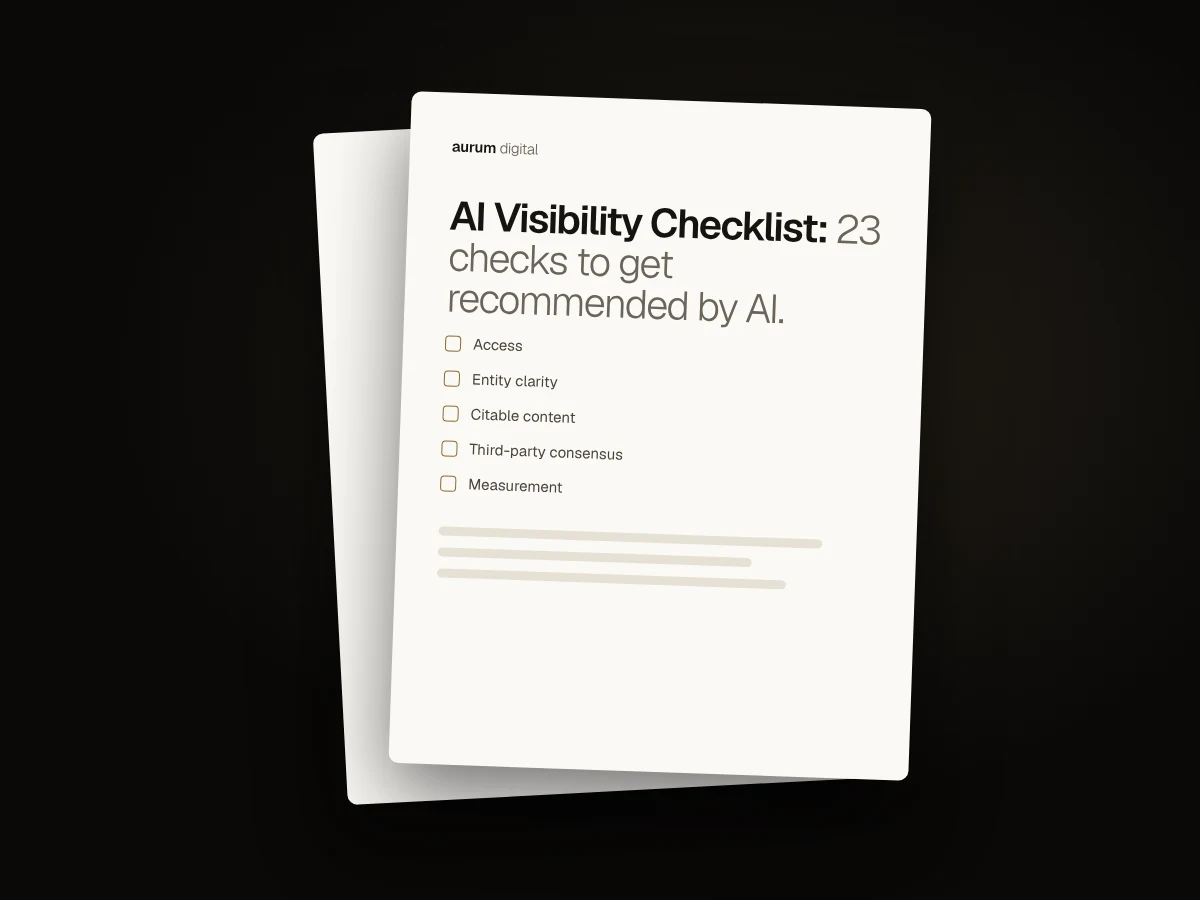
- Measurement. Track a fixed set of buyer questions across the main AI platforms, record whether and how your brand appears, and repeat the exercise regularly so you can see what your work is changing.
If these sound familiar, that is the point: the foundations are shared with good SEO. Our technical SEO, digital PR and GEO services are run as one program for exactly this reason.
How to measure GEO
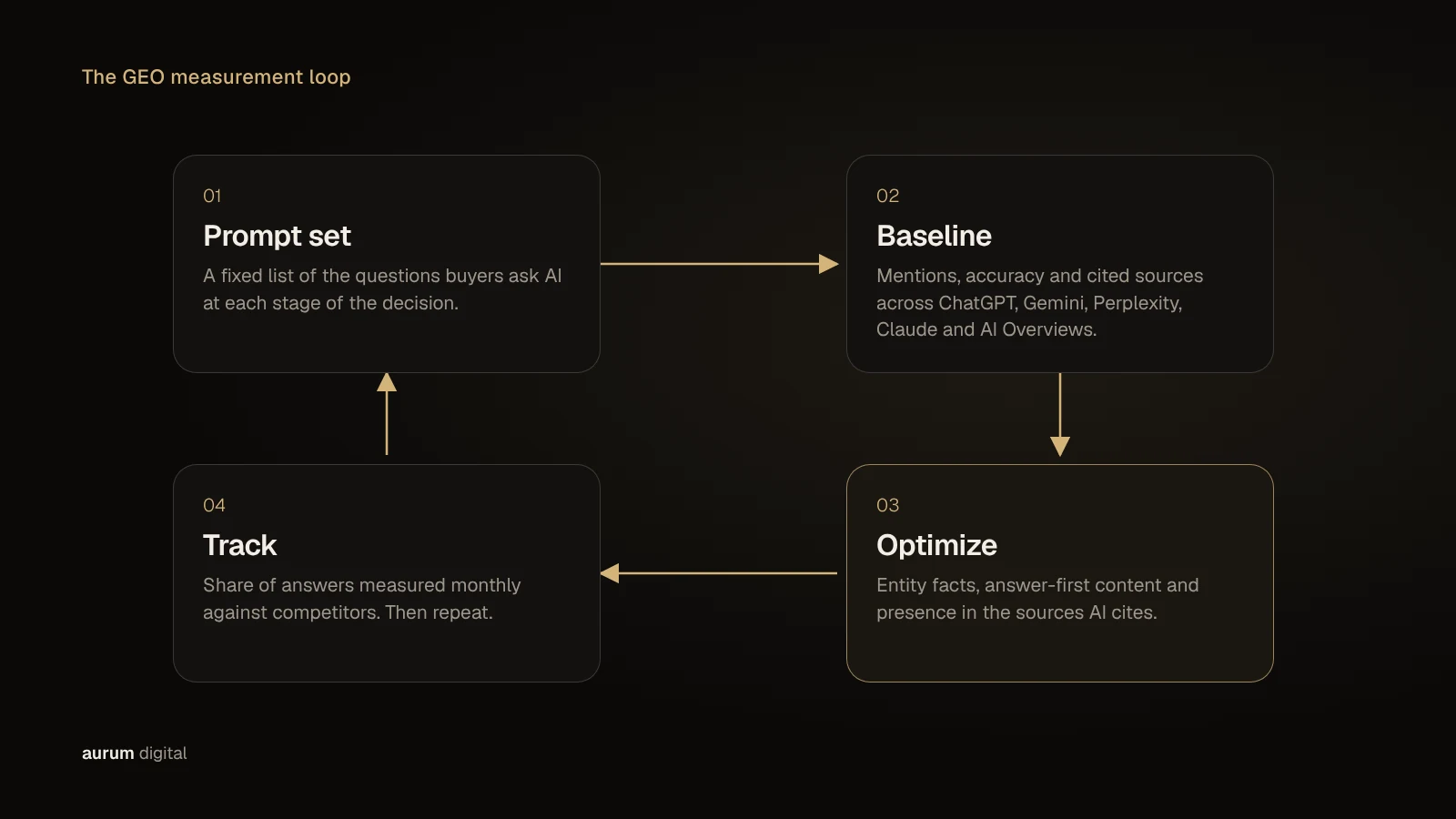
Traditional rank trackers do not show whether ChatGPT recommends you. GEO measurement starts with a prompt set: a fixed list of questions your buyers actually ask at each stage of their decision, from broad category questions to direct comparisons.
For each question and platform you record whether your brand is mentioned, where it appears, whether the description is accurate and which sources are cited. Across the full set, the share of answers that mention you, sometimes called share of voice or Share of Model, becomes your headline metric. Because AI answers vary from one run to the next, the trend over several measurements matters more than any single result.
The cited sources are just as useful as the mentions. They show you which publications, review sites and pages the assistants trust in your market, and therefore where your digital PR and content efforts will have the most effect.
Common GEO myths
- "GEO is a new set of tricks." There is no hidden switch. The work is making accurate, well-supported information easy to find, and it overlaps heavily with SEO.
- "Adding an llms.txt file will get us cited." llms.txt is a proposed file that summarizes a site for AI systems. It is cheap to add, but it is not an official standard and there is little public evidence that major assistants rely on it, so treat it as a small extra rather than a strategy. If you want one anyway, our free llms.txt generator creates it in a minute.
- "We can pay to be recommended." Organic AI answers cannot be bought. Some platforms are introducing clearly labeled advertising, which is a separate channel with its own rules.
- "Keyword stuffing works on AI." Language models are built to understand meaning. Repeating phrases does not make content more trustworthy; clear answers and independent corroboration do.
How to get started with GEO
- Ask the assistants yourself. Write down ten questions a buyer would ask before choosing a company like yours, and put them to ChatGPT, Gemini, Perplexity and Claude. Note who is mentioned, what is said about you and which sources are cited.
- Fix your facts. Make your company description, services, locations and key facts consistent across your website, social profiles and directories, and add Organization structured data.
- Strengthen your answer pages. Make sure each important service or product page answers the main buyer questions directly, with specific, verifiable information.
- Earn presence where AI looks. Use the cited sources from step one as a target list for digital PR, reviews and directory profiles.
- Measure again. Repeat the same questions every month and compare. That baseline turns GEO from guesswork into a managed channel.
If you would rather have this done for you, our free audit includes a first check of how AI assistants describe your brand today. For definitions of the terms used in this guide, see our SEO and GEO glossary, and for a spoken introduction, listen to episode 1 of Be the Answer.
FAQ
Frequently asked questions
What does GEO stand for in marketing?
GEO stands for Generative Engine Optimization: improving how AI assistants and AI search features such as ChatGPT, Gemini, Perplexity, Claude and Google AI Overviews mention, describe and cite a brand.
Is GEO the same as AEO or AI SEO?
Yes. Generative Engine Optimization, Answer Engine Optimization and AI SEO are different names for the same discipline: making a brand visible and accurately represented in AI-generated answers.
Does GEO replace SEO?
No. GEO builds on SEO. AI assistants often find their sources through search, so crawlable pages, clear content and authoritative links remain the foundation. GEO adds entity work, a focus on third-party consensus and a different way of measuring results.
How long does GEO take to show results?
Answers that rely on live retrieval can change within weeks once new content or coverage is indexed. What a model knows from training changes more slowly, with new model versions. Most brands should expect to measure progress over several months.